
The Updated Dignity in Pregnancy & Childbirth Course
California Training Requirements +
Federal Civil-Rights Expectations
We developed the Updated Dignity in Pregnancy and Childbirth course so it both meets new California training requirements and is likely to align with new federal standards. The evidence base, the clinical problems addressed, and the recommended practices remain the same.
Healthcare organizations are navigating California requirements that explicitly reference “implicit bias” and related concepts, alongside an evolving federal civil-rights enforcement environment that is closely examining how workplace training is framed and implemented. This one-pager summarizes how Humanitas Institute training is designed to support both by focusing on universal human decision processes under clinical pressure and practical safeguards that strengthen reliable, consistent care for every patient.
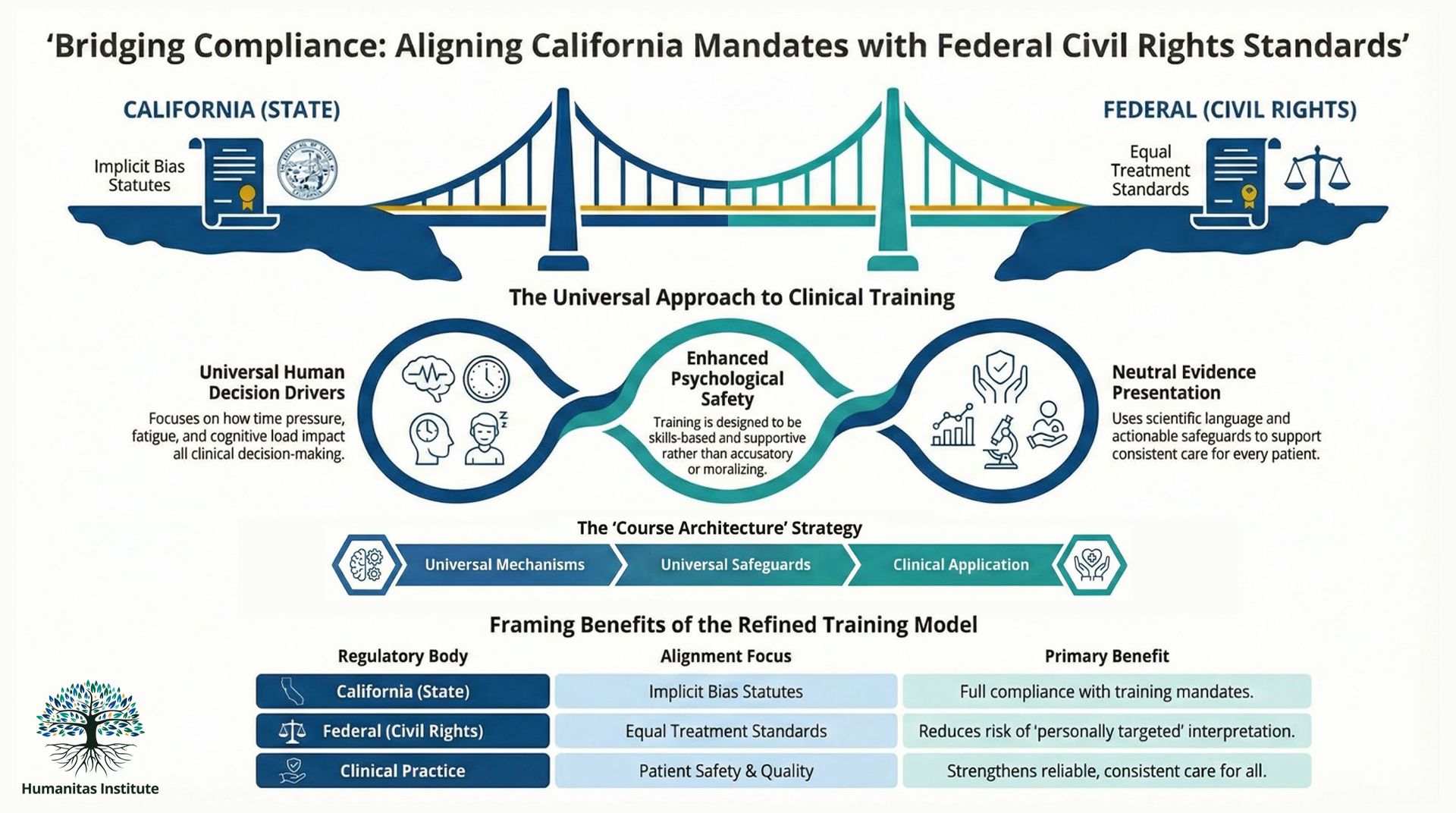
Refinement in Our Approach
These refinements are intended to reduce misinterpretation risk and increase learner engagement—
without changing the evidence base or the effective, evidence-based, and practical recommended clinical practices.
What Stays the Same?
Evidence base
- Training remains grounded in peer-reviewed clinical, behavioral, and health-services research.
Problem analysis
- Training continues to address documented differences in care experiences and outcomes reported across patient groups in specific clinical contexts.
Clinical focus
- Patient safety, quality, reliability of clinical decisions, and consistent communication and treatment processes.
Recommendations
- Skills and safeguards are universally applicable—designed to support consistent, high-quality care for all patients.
What We Are Strengthening
Enhanced clarity on cross-cutting and universal human cognitive mechanisms that lead to variations in care for different patient populations
- Reinforces that common drivers of inconsistent decisions (time pressure, incomplete information, cognitive load, fatigue, interruptions, and default assumptions) are universal features of human decision-making in fast-paced clinical work.
Enhanced psychological safety design
- Goes even further to strengthen cues that the training is skills-based, practical, and supportive and not accusatory or moralizing.
- Reduces defensiveness and increases openness to learning, supporting stronger uptake across diverse clinical roles, socio-political orientations and settings.
Reduced risk of “personally directed” interpretation
- Further refines language, examples, and facilitation guidance to avoid content that could be interpreted as targeting, stigmatizing, or assigning moral judgment to any group of learners—while preserving the same evidence and universal improvement tools.
Contact us for more information or to access courses
How This Bridges California Requirements
and Federal Civil-Rights Interpretations
California alignment
- Course content remains responsive to California-required topics and training expectations, including statutes and guidance that use terms such as “implicit bias.”
- Training supports mandated goals by strengthening decision reliability, communication, and consistent care processes that reduce avoidable gaps in care.
Federal alignment benefit
- Training is framed around universal standards of care, equal treatment, and consistent clinical processes.
- Instructional design avoids race/sex-based assignment of burdens or benefits, avoids segregating or classifying learners, and avoids compelled identity-based statements—reducing the likelihood of training being interpreted as personally targeted or creating a hostile-work-environment concern.
Design Safeguards Used in the Training
Our instructional design emphasizes practical clinical application and shared goals,
while avoiding elements that can make training feel personally targeted.
Practice-focused language:
Shared-purpose framing:
Evidence presented neutrally:
Universal application:
IMPORTANT!
* This is for general informational/educational purposes only and is not legal or compliance advice. Laws, agency interpretations, and enforcement priorities may change, and application depends on your specific facts.
Your organization is solely responsible for any decisions or actions taken based on this information. Humanitas Institute is not liable for any outcomes, claims, costs, or enforcement actions arising from its use.
Use this information in consultation with your legal/compliance team. No attorney-client or consulting relationship is created.
Sources
- U.S. Department of Justice, Office of Public Affairs. (2025, May 19). Justice Department establishes Civil Rights Fraud Initiative. https://www.justice.gov/opa/pr/justice-department-establishes-civil-rights-fraud-initiative
- U.S. Department of Justice. (2025, July 29). Guidance for recipients of federal funding regarding unlawful discrimination (Memorandum). https://www.justice.gov/ag/media/1409486/dl
- U.S. Department of Health and Human Services, Office for Civil Rights. (2025, March 6). Summary of guidance to federal financial assistance recipients regarding Title VI and the prohibition against national origin discrimination affecting limited English proficient persons.
https://www.hhs.gov/civil-rights/for-providers/laws-regulations-guidance/guidance-federal-financial-assistance-title-vi/index.html
- Office for Civil Rights, U.S. Department of Health and Human Services. (2024, May 6). Nondiscrimination in health programs and activities (Final rule). Federal Register. https://www.federalregister.gov/documents/2024/05/06/2024-08711/nondiscrimination-in-health-programs-and-activities
- U.S. Equal Employment Opportunity Commission. (2024, April 29). Enforcement guidance on harassment in the workplace. https://www.eeoc.gov/laws/guidance/enforcement-guidance-harassment-workplace
- Congressional Research Service. (2022, May 18). Federal financial assistance and civil rights requirements (R47109). Congress.gov. https://www.congress.gov/crs-product/R47109
Featured links
Get in touch
-
Email:
-
solutions@humanitasinst.org
-
help@humanitasinst.org
-
Phone:
-
612-524-5841